
Gambling should remain a paid form of entertainment, not a way to cover rent, repay debt or create regular income. The safest decision is not to gamble. Anyone who chooses to play should use money that can be lost without affecting food, housing, transport, education, healthcare or family commitments.
NGBoom is an information site and does not provide treatment. If gambling is causing distress, debt, secrecy, conflict or loss of control, stop depositing and contact a qualified support service. Gambling Therapy provides free global practical advice and emotional support, including multilingual resources for people who gamble and for affected family members.
A quick action plan
Situation | Action today | Tool or evidence | Next check |
Spending more than planned | Stop all new deposits | Bank statement and casino transaction history | Calculate the full 30-day total |
Chasing a loss | End the session immediately | Log out and remove saved payment methods | Do not return to recover money |
Repeated late-night play | Set a device and operator block | BetBlocker or an account timeout | Tell someone you trust |
Borrowing to gamble | Separate money from gambling access | Bank gambling block and bill payments | Contact a debt adviser |
Hiding activity | Share the real totals with a trusted person | Account and bank records | Agree on practical safeguards |
Unable to stop | Request self-exclusion from every operator used | Written confirmation from each account | Add device-level blocking |
Distress or thoughts of self-harm | Seek urgent help now | Local emergency service or nearest emergency department | Do not stay alone |
Affected by another person | Protect shared money and seek support | Separate accounts and Gambling Therapy resources | Set boundaries with professional guidance |
Warning signs that deserve attention
One large loss is not the only warning. Harm can develop through many small deposits, long sessions and repeated attempts to win back earlier spending. The NHS identifies questions about unaffordable betting, needing larger amounts for the same feeling, chasing losses, borrowing, stress, criticism from others, financial problems and guilt.
- You spend more money or time than intended.
- You return quickly to recover a loss.
- You increase stakes to create the same excitement.
- You borrow, sell belongings or delay bills to continue.
- You hide transactions, accounts or session length.
- Sleep, work, study, relationships or health are affected.
- You feel anxious, irritable or restless when trying to stop.
- You keep gambling after deciding that you do not want to.
A person does not need to meet every sign before asking for help. Any effect on essential finances, mental health or relationships is enough reason to act.
Do not treat gambling as income
Casino games include a mathematical house advantage, and sportsbook prices include an operator margin. Short-term wins can happen, but neither creates a dependable salary. A balance shown on screen is not household income until it has been withdrawn, received and separated from further play.
Chasing losses changes the goal from entertainment to recovery. It often increases stake size and extends the session when judgment is already under pressure. A previous result does not make the next slot spin, crash multiplier or match outcome more likely to repay it.
Set limits before opening an account
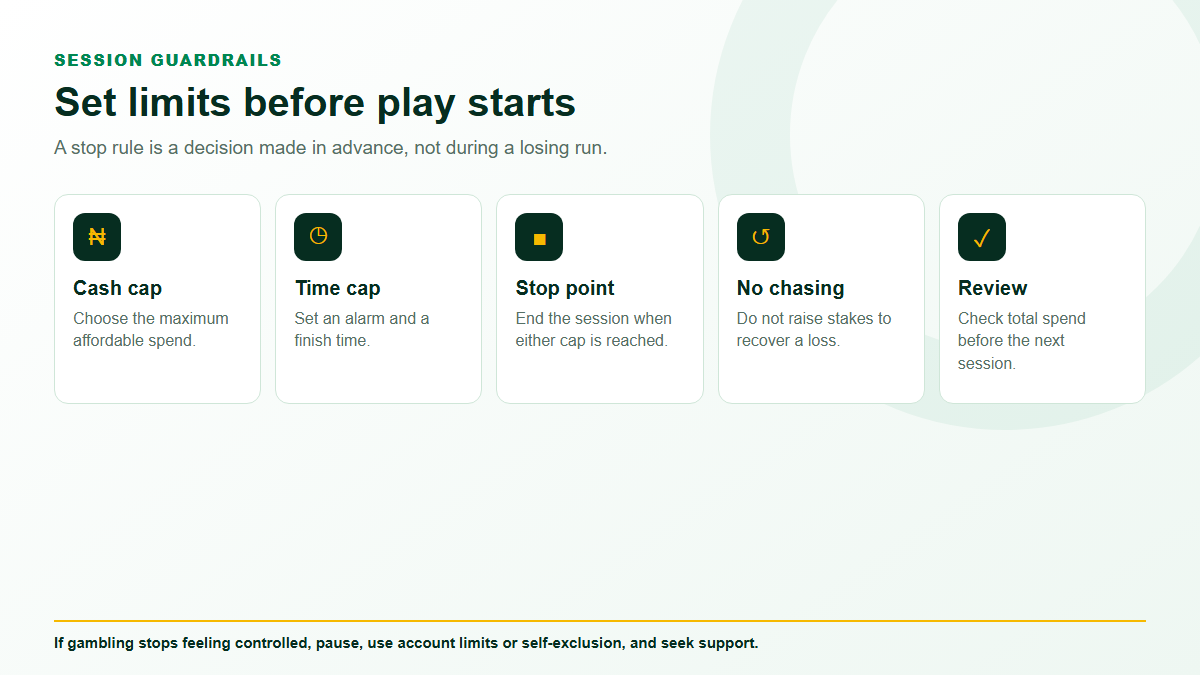
- Create a weekly entertainment amount after essential bills and savings.
- Use a deposit limit that cannot exceed that amount.
- Set a loss limit if the operator offers one.
- Set a session timer and a fixed finishing time.
- Disable promotional notifications that trigger unplanned play.
- Do not save a credit card or borrowed-money route.
- Keep a complete record across every operator, not one account at a time.
Limits work best when they are set during a calm period. Increasing a limit immediately after a loss defeats its purpose. If an operator applies a cooling-off delay to an increase, leave the pending increase alone and use the delay to reconsider it.
Track the real amount, not memorable wins
Memory gives extra weight to a large win and can overlook frequent deposits. Use bank, wallet and operator histories to calculate total money sent, total money received and net spending over a fixed period. Include every betting account and cash payment.
- Download the last 30 or 90 days of payment records.
- Mark every gambling deposit and withdrawal.
- Add all deposits together.
- Add all received withdrawals together.
- Subtract withdrawals from deposits to find net spending.
- Compare the result with the amount originally planned.
- Share the calculation with a trusted person if secrecy has developed.
Timeouts and self-exclusion are different
A timeout blocks play for a chosen short period. Self-exclusion is a stronger request to close access for a longer period defined by the operator or programme. Use self-exclusion when repeated limits and breaks have not stopped the behaviour or when access itself creates harm.
Request the restriction from every operator used, not only the account with the largest loss. Ask for written confirmation and whether related accounts or marketing messages are covered. Do not try to bypass an exclusion with a new domain, altered details or another person’s account.
Blocking software adds another layer
BetBlocker is a free blocking tool designed to restrict gambling websites and apps. Its site also provides parental-control options and a responsible gambling directory. Gambling Therapy publishes guidance on blocking sites as part of its global support resources.
- Install the blocker on every phone, tablet and computer used.
- Choose a restriction period long enough to interrupt the routine.
- Let a trusted person control installation settings where appropriate.
- Remove saved casino passwords and payment details.
- Ask the bank or wallet whether a gambling-transaction block is available.
- Block promotional email, SMS, push notifications and social accounts.
Software is most effective when combined with account exclusion, payment controls and human support. A blocker alone cannot address debt, anxiety or relationship harm.
Protect essential money first
Pay rent, utilities, food, transport, school and healthcare costs immediately after income arrives. Automated bill payments and a separate essential-expenses account reduce the amount visible in a spending account. Do not use loans, overdrafts, salary advances or money held for another person.
If debt has already developed, stop new gambling and list every balance, rate, due date and missed payment. Contact a qualified debt adviser or financial counsellor serving your location. Hiding one debt to obtain another usually makes the position more difficult.
Support for family and friends
Another person’s gambling can affect shared money, housing, children and emotional safety. Gambling Therapy provides support for friends, family members and colleagues, not only the person who gambles. Affected people are allowed to seek help even when the gambler is not ready.
- Protect shared accounts and important documents.
- Do not lend money to cover a gambling loss.
- Avoid paying debts without a wider safety plan.
- Use specific bank records rather than arguing about remembered amounts.
- Set boundaries that can actually be maintained.
- Seek professional support for yourself and any children affected.
Children and account access
Gambling accounts are for adults who meet the applicable minimum age. Never let a child use an adult account, phone, payment wallet or identity. Keep passwords and payment PINs private, disable lock-screen notification previews and use device parental controls.
Games with casino-like mechanics can normalise staking even when they use virtual items. Talk plainly about chance, advertising and the difference between entertainment spending and income. If a child has accessed gambling, secure the accounts and seek age-appropriate professional support.
Urgent mental-health help
Gambling harm can become a mental-health emergency. If you or another person may act on thoughts of self-harm, seek urgent help now through local emergency services or the nearest emergency department. Stay with the person, remove immediate access to money and gambling, and contact someone trusted. Do not rely on an online article or wait for a casino support reply.
Verified support resources
- Gambling Therapy: gamblingtherapy.org — free global practical advice and emotional support, multilingual information, forums and help for affected others.
- BetBlocker: betblocker.org — free software for blocking gambling sites and apps, plus a responsible gambling directory.
- NHS gambling-harm information: nhs.uk/live-well/addiction-support/gambling-addiction — warning signs, self-check questions and practical steps.
- Your bank or payment wallet — ask whether merchant blocks, card freezes or spending controls are available.
- The operator’s account tools — set deposit limits, take a timeout or request self-exclusion in writing.
Services listed outside Nigeria may offer online information but have country-specific treatment or telephone coverage. For local clinical care, contact a qualified Nigerian mental-health professional, hospital or emergency service.
Responsible Gambling: practical questions
What is responsible gambling?
It means treating gambling as optional entertainment, using only affordable money, setting firm limits and stopping when it affects finances, health or relationships.
What is chasing losses?
It is continuing or increasing stakes to recover money already lost. Previous results do not make the next outcome more likely to repay the loss.
When should I use self-exclusion?
Use it when access itself is harmful, when limits repeatedly fail or when you cannot stop. Apply it to every operator used and add payment and device blocks.
Can blocking software stop all gambling?
It can restrict access but works best with account exclusion, financial controls and professional or personal support.
Where can someone in Nigeria get online support?
Gambling Therapy offers free global online support and multilingual resources. BetBlocker provides free blocking software. Local healthcare and emergency services are important for clinical or urgent needs.
What should I do if gambling has created debt?
Stop new deposits, protect essential bills, list every debt and contact a qualified debt adviser or financial counsellor. Do not borrow again to gamble.
What if someone may harm themselves?
Treat it as an emergency. Contact local emergency services or go to the nearest emergency department, stay with the person and involve someone trusted.